The Year book of the United States Brewers' Association by United States Brewers' Association
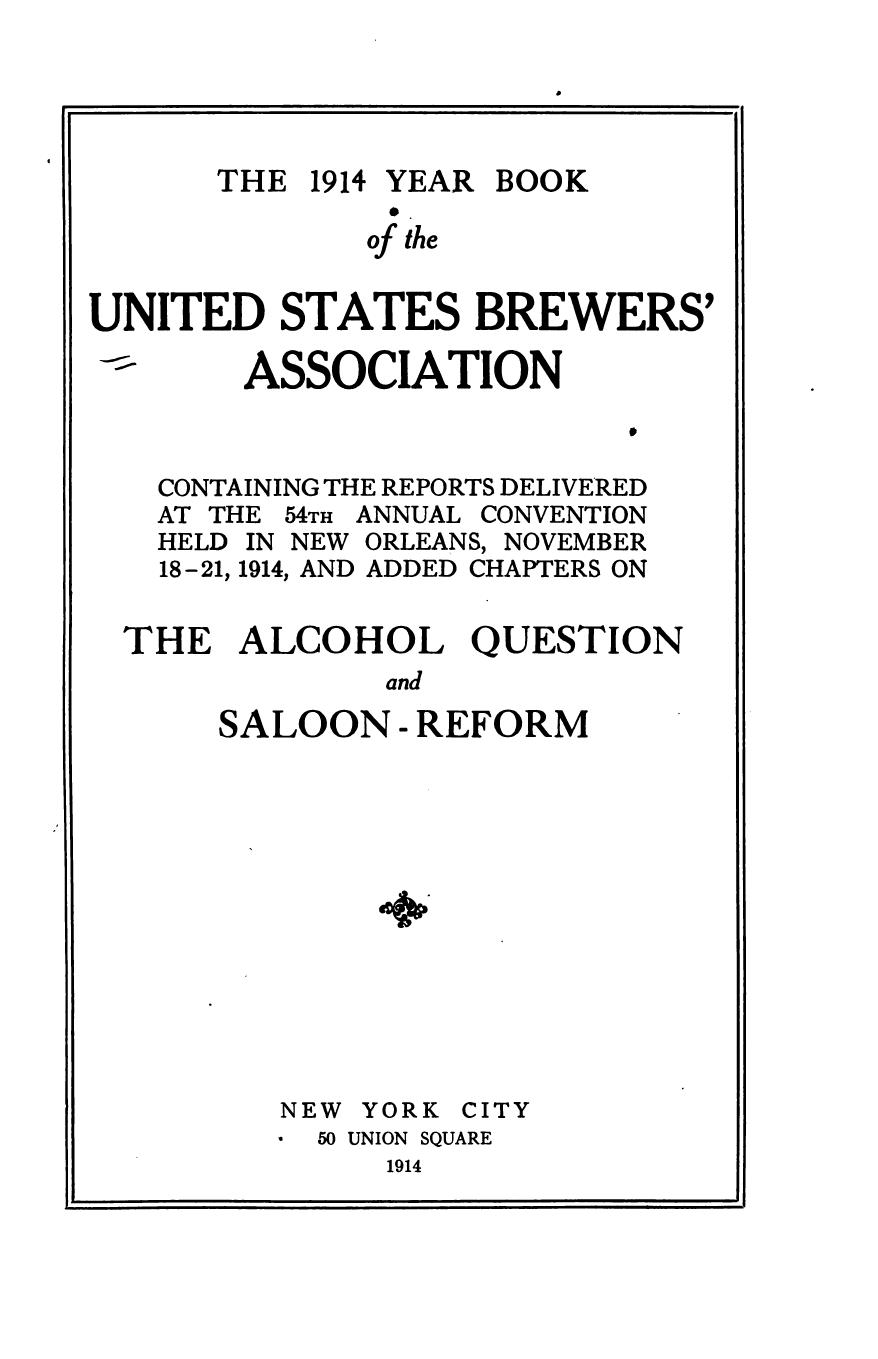
Author:United States Brewers' Association
Language: eng
Format: epub, pdf
Tags: Brewing industry, Brewing industry, Alcoholic beverage industry, Liquors
Publisher: New York : The Association
Published: 1909-03-25T05:00:00+00:00
respectively, 21.3 and 24.5. Yet both of the last mentioned State groups are swayed by a strong temperance sentiment and have a large territory under prohibition.
Why in the face of such facts, which could be multiplied almost indefinitely, the view of the liquor habit as the chief source of criminality should maintain its currency is not difficult to understand. For the most part unenlightened authorities treat the confirmed drunkard as a criminal whenever he is apprehended. He consequently figures very largely in the prison returns. It is perhaps natural for superficial minds to argue from this to a causal relation between crime and drink in general. If the matter is made one of special inquiry similar conclusions are easily reached, especially if they are desired. Prisoners, especially the real criminals, are quick to discover whether their interrogator has a violent prejudice against liquor and are perfectly willing to cater to it. Furthermore, there is no explanation of the cause of crime so convenient; it relieves one from groping among less palpable forces that influence for evil, and it is an explanation containing an excuse from the prisoner's point of view when he can say, " I did this when I was not myself, because I was dnmk." Therefore, one who sets out to discover that most crime is attributable to drink will find plenty of apparently corroborative evidence which, however, does not as a rule establish the truth.
Leaving out of consideration the many men and women whose sole offense is dnmkenness, there is a considerable class of semi-criminals or occasional criminals who are more or less intemperate. It is far from obvious, however, that intemperance is the direct cause of their criminal doings. They are, as Dr. Branthwaite has pointed out, mentally imsound, and commonly as a result of congenital defects, which, of course, become intensified by drink or any other vice. How far such persons should be reckoned socially responsible and how an enlightened commtmity should deal with them, is not to be discussed here. Suffice it to say that it is the habit of society in these cases to try and cure natural defects by imprisonment.
That a criminal condition may also have a physiological basis entirely distinct from degeneration due to alcohol in the case of the professional criminal, is generally agreed upon by criminologists. Offenders of this class often require a skill and nerve which is not possessed by the inebriate. Most of them begin their criminal
career while young, or long before habits of intemperance might become fixed. The causes that lead them to a criminal life are usually very complex. It may be a combination of environment, lack of training (industrial and moral), a degenerate organism, etc. In most instances a criminal condition springs from a variety of causes that are exceedingly difficult to disentangle. But intemperance is rarely a direct cause of professional crime. That the confirmed or habitual criminal frequently ends life as an inebriate is another story.
A third class of persons foimd in prisons consists of accidental offenders.
Download
The Year book of the United States Brewers' Association by United States Brewers' Association.pdf
This site does not store any files on its server. We only index and link to content provided by other sites. Please contact the content providers to delete copyright contents if any and email us, we'll remove relevant links or contents immediately.
Whiskies (Collins Gem) by dominic roskrow(45527)
101 Whiskies to Try Before You Die by Ian Buxton(45319)
World's Best Whiskies by Dominic Roskrow(45122)
Whiskies Galore by Ian Buxton(42156)
The Fast Metabolism Diet Cookbook by Haylie Pomroy(21256)
Chic & Unique Celebration Cakes by Zoe Clark(20149)
Craft Beer for the Homebrewer by Michael Agnew(18343)
The Bone Broth Miracle: How an Ancient Remedy Can Improve Health, Fight Aging, and Boost Beauty by Ariane Resnick(16705)
For the Love of Europe by Rick Steves(14907)
Tools of Titans by Timothy Ferriss(8593)
Chowders and Soups by Liz Feltham(8440)
A Court of Wings and Ruin by Sarah J. Maas(8110)
How to Be a Bawse: A Guide to Conquering Life by Lilly Singh(7613)
The Institute by Stephen King(7151)
Cravings: Recipes for All the Food You Want to Eat by Chrissy Teigen & Adeena Sussman(6862)
Wiseguy by Nicholas Pileggi(5934)
The Last Wish (The Witcher Book 1) by Andrzej Sapkowski(5593)
Spare by Prince Harry The Duke of Sussex(5368)
Room 212 by Kate Stewart(5271)
